
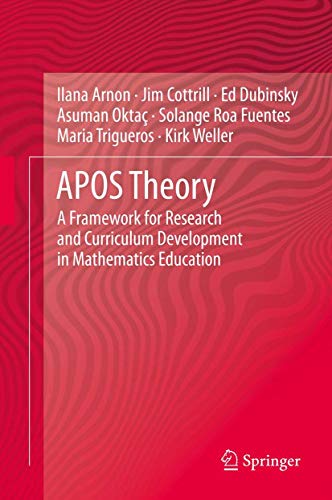
APOS theory : a framework for research and curriculum development in mathematics education / Ilana Arnon, Jim cottrill, Ed Dubinsky, [y otros cuatro]
Material type: TextPublisher: New York : Springer, 2014Description: xi, 254 páginas : ilustraciones, tablas, diagramasContent type:
 - texto
- No mediado
- Volumen
- 978-1-4614-7965-9 (tapa dura)
- 978-1-4899-9825-5
- 510.71 A645 21
| Item type | Current library | Collection | Call number | Status | Notes | Date due | Barcode | |
|---|---|---|---|---|---|---|---|---|
 Libros Impresos
|
Central | Proyecto | 510.71 A645 (Browse shelf(Opens below)) | Checked out | UPA 22991-LABESAM | 30/10/2026 | 2025-0347 | |
|
Libros Impresos
|
Central | Proyecto | 510.71 A645 (Browse shelf(Opens below)) | Checked out | UPA 22991-LABESAM | 30/10/2026 | 2025-0346 | |
|
Libros Impresos
|
Ciencias e ingeniería Circulación | Colección General | 510.71 A645 (Browse shelf(Opens below)) | Available | 114421 | |||
|
Libros Impresos
|
Ciencias e ingeniería Circulación | Colección General | 510.71 A645 (Browse shelf(Opens below)) | Available | 116094 |
Browsing Ciencias e ingeniería shelves, Shelving location: Circulación, Collection: Colección General Close shelf browser (Hides shelf browser)


Includes bibliographical references (p. 227-232) and index.
1. Introduction -- 2. From Piaget's theory to APOS theory : reflective abstraction in learning mathematics and the historical development of APOS theory -- 3. Mental structures and mechanisms : APOS theory and the construction of mathematical knowledge -- 4. Genetic decomposition -- 5. The teaching of mathematics using APOS theory -- 6. The APOS paradigm for research and curriculum development -- 7. Schemas, their development and interaction -- 8. Totality as a possible new stage and levels in APOS theory -- 9. Use of APOS theory to teach mathematics at elementary school -- 10. Frequently asked questions -- 11. Conlusions -- 12. Annotated bibliography
Although APOS Theory has been used extensively in numerous scholarly publications, in the design of textbooks, and in teaching practice, there is no single reference that contains all the relevant information about its components, and provides guidance about its application. The goal of this book is to present the main elements of APOS Theory and its use. The book is intended to be useful for Mathematics Education researchers, graduate students in Mathematics Education, and Mathematics instructors who work with, or would like to learn more about, this theoretical approach, and who are interested in how, according to this theory, individuals construct their understanding of mathematical concepts -- $c Source other than Library of Congress.
Texto en inglés